Tribute Upheaval

A bestiary, in progress.

Every creature is a continuous skinned surface bound to at most 32 bones, compiled by the same reference implementation that defines what the console's silicon must produce, and rendered one frame at a time at 384 by 240 through the real RGB565 path. The crayon on them is lifted from the concept drawings themselves.

Zixxtrixx

snake

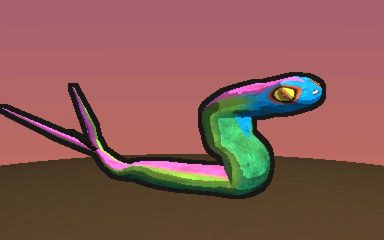
The first creature, from two concept sheets by S. Hofer. One continuous chain of 20 sides and 57 stations whose taper is measured off the drawing itself, wearing crayon lifted from the same scans. Twenty-seven bones. He has one trick. He also has six tricks.

Idle, 96 keys, three breaths per camera revolution

The canonical S: front reared, middle dipped, tail carried high. Deliberately relaxed and slow. Four things happen at once on four different periods, so the loop never resolves into a single oscillation -- the whole S gathers and releases on a 3.2 s breath, the animal bobs vertically, the body swells and shrinks in girth, and the tail sways lazily left and right. The girth rides the instance bulk, because a clip carries rotations and a root offset but not scale.

Caterpillar gait, 40 keys, three cycles, fixed camera

Locomotion is vertical and longitudinal, not lateral: an arch travels down the body, the middle rises and bunches, the rear is drawn forward. The head and neck bob with it. A small roll survives as secondary life at a fraction of the vertical authority. The camera is deliberately fixed -- a gait has to be legible before an orbit is allowed anywhere near it.

Triple salto mortale, 72 keys, contact on key 45

Zixxtrixx does not bite. He coils, throws his whole body through three overhead somersaults, then STRAIGHTENS INTO A RIGID SPEAR and drives straight down. The turn is spread across all nineteen spine joints rather than wagging the last three tail bones, and the coil parameter runs from fully relaxed to zero, so at the moment of the stab there is no give left in the animal at all.

Falling flail loop, 48 keys, four cycles per revolution

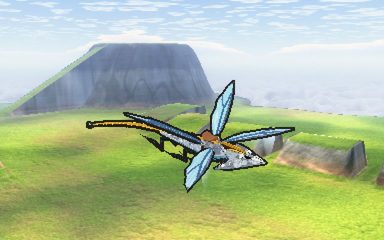
Panicked and uncontrolled. The body corkscrews, the head end counter-rotates against the tail end, the blades flap and splay. Every joint runs three incommensurate periods so the loop never settles into a clean sine -- a falling animal that oscillates neatly reads as a machine.

Earlier passes, newest first. Every one of these was the creature at the time, and each is kept with what was wrong with it -- the record is the point.

ARCHIVE, 2026-08-27: the second idle

The canonical S, breathing on four incommensurate periods. The motion was right and was frozen -- what dates this pass is the surface it moved: a flat-shaded 4,370-triangle tube, an indexed page sampled nearest so the crayon reads as pixels, and a dorsal pink narrowed to a thin stripe to compensate for a camera pitch that had already been fixed.

ARCHIVE, 2026-08-27: the second walk

The caterpillar gait and the head-bob, both frozen and carried forward unchanged. Same surface as the idle above, and the same flat face: at the eye stations the skull was 1.97 times as wide as it was tall, which is a disc, not a head.

ARCHIVE, 2026-08-27: the second salto

Three overhead somersaults into a rigid spear. The trajectory, the 12-metre apex, the aligned plunge and the impact shake are all frozen. Kept because it is the pass that proved the animation system works while the head was at its worst.

ARCHIVE, 2026-08-27: the second falling flail

The corkscrew after it was slowed down -- three fast incommensurate terms per joint had read as vibration rather than as a body yielding. Fewer and slower, not more and faster.

The first Zixxtrixx: a flat horizontal snake with muted colours
ARCHIVE, 2026-08-26: the first pass

Kept deliberately. Ten independent rigid cylinders at six sides and about 450 vertices, a horizontal ground-snake silhouette, and colours taken as the MEDIAN of each crayon region -- which is the pigment lightened by however much paper showed through, and was then hand-saturated to compensate. The orange was deleted outright to fit a 256-colour GIF palette. This is what the creature looked like when an export format was allowed to decide its shape.

The first Zixxtrixx attack, with the tail arcing up and back
ARCHIVE, 2026-08-26: the first tail strike

The tail rose to vertical and came back down behind the animal, because the per-joint rotation was rear-weighted and the accumulated turn was therefore a fifth of what it looked like on paper. The joints also switched between two rotation axes on a magnitude threshold, which popped as they crossed. Both are fixed; this is the record.