Zixxtrixx
snake
The first creature, from two concept sheets by S. Hofer. One continuous subtly tapered tube swells into its face rather than wearing a separate skull, then runs through a weight-bearing middle into a thin forked tail. Twenty-eight bones carry the bend, coordinated pupils and boundary-reaching orange stripes; an identity-default fixed-point sidecar adds real positive-volume radial squash only to the authored spring brace. The accepted neutral body and Cool Cross remain fixed while the spring now ARMS BY PEELING: the contact leaves the ground at the front of the grounded stretch and rolls backward along the body until the animal stands on the end of its tail, then compresses hard on it — the face blue resolves into a centred point, and restrained eye and impact language gives each performance its own intention.
Owner Direction 30 sun: a calm golden-morning sun rides high on the +X/+Z quarter of the orbit. Direction 29's first authoring was so strong it read as one super-bright white sun on every clip -- the hue clamped away at the channel ceiling -- so the emission is cut to roughly a quarter and the gains to a third, with secondary channels suppressed so the colour stays nameable over the green-rich pigment. The emission still rides the same lambert response as the multiplicative gain (light shapes to the form, unlit faces stay unlit), the additive term is simply the bank's normal light model now, the accepted Cool Cross rig still carries base modelling and pigment underneath, and the animation is untouched. The accepted continuous S breathes on its authored 192-frame clip period. The 576-frame orbit now repeats the instance girth with each of its three real breaths instead of stretching one scale cycle across the whole presentation. Neutral shape and posed normals stay fixed; the repaired pigment carries one centred face-blue wedge through the junction to a distinct point, surrounded by dark then light green.
Owner Direction 30: the additive term is the NORMAL light model, so this is the one moving-light clip — the Direction 28 prototype's settings became the shipped settings and the separate experimental entry is retired (that clip is preserved in Archive Generation Nineteen). Four world-space sources on their authored Direction 27 paths: the tamed warm inspection lamp, which emits nothing — restraint is part of the shipped settings; a blue source with a gentle 0.20 true-blue emission; a RED lamp emitting 0.55 true red that crosses the green body as genuinely red light, the case multiplicative transport cannot show and the reason the term was approved; and a green source with a 0.16 emission. Every emission rides the same lambert times attenuation response as its multiplicative gain, so the light shapes to the form and unlit faces stay unlit; everything accumulates and saturates once at the end, so overlapping pools genuinely mix. Every colour, radius, gain, path extent, period and phase remains a named owner constant; the depth-tested orbs (the third orb is red, agreeing with its light) and the 599-to-0 seam are unchanged. The revert gate remains while the silicon ALM/M10K sizing sweep is pending: with the whole Direction 29/30 look gated off, the bank reproduces the pre-suns Generation Eighteen byte-for-byte, proven by CRC.
Owner Direction 30 sun: a calm azure-day sun rides high on the camera-left sky. Direction 29's first authoring was so strong it read as one super-bright white sun on every clip -- the hue clamped away at the channel ceiling -- so the emission is cut to roughly a quarter and the gains to a third, with secondary channels suppressed so the colour stays nameable over the green-rich pigment. The emission still rides the same lambert response as the multiplicative gain (light shapes to the form, unlit faces stay unlit), the additive term is simply the bank's normal light model now, the accepted Cool Cross rig still carries base modelling and pigment underneath, and the animation is untouched. The accepted locomotion reference is unchanged: a broad arch travels down the grounded run, bunches the body and draws the rear forward while the signature S and planted contact survive. Cool Cross follows the repaired outward posed normals, so the smooth toon bands stay attached to this deforming surface instead of flickering between bone responses.
Owner Direction 30 sun: a calm hot-orange sun rides high on the camera-right sky. Direction 29's first authoring was so strong it read as one super-bright white sun on every clip -- the hue clamped away at the channel ceiling -- so the emission is cut to roughly a quarter and the gains to a third, with secondary channels suppressed so the colour stays nameable over the green-rich pigment. The emission still rides the same lambert response as the multiplicative gain (light shapes to the form, unlit faces stay unlit), the additive term is simply the bank's normal light model now, the accepted Cool Cross rig still carries base modelling and pigment underneath, and the animation is untouched. The same caterpillar law at a hungry cadence: a taller, broader hump crosses the grounded run every 0.8 seconds, the front wave digs deeper and the nose leans into travel. Contact compensation remains exact while the projected-size ink keeps the moving silhouette coloured.
Owner Direction 30 sun: a calm violet sun rides high left of the three-quarter camera. Direction 29's first authoring was so strong it read as one super-bright white sun on every clip -- the hue clamped away at the channel ceiling -- so the emission is cut to roughly a quarter and the gains to a third, with secondary channels suppressed so the colour stays nameable over the green-rich pigment. The emission still rides the same lambert response as the multiplicative gain (light shapes to the form, unlit faces stay unlit), the additive term is simply the bank's normal light model now, the accepted Cool Cross rig still carries base modelling and pigment underneath, and the animation is untouched. The body idles while the skull turns left, up, right, down and home with eased arrivals and soft neck follow. The two pupils aim together with restrained holds and a modest lag instead of wandering independently. Both eye discs, their local support and shared pupil pivot have moved noseward as one bounded system; the orange vertical stripes still extend and contract to the eye boundary through vertical and diagonal travel.
Owner Direction 30 sun: a calm teal sun rides high on the camera-right sky. Direction 29's first authoring was so strong it read as one super-bright white sun on every clip -- the hue clamped away at the channel ceiling -- so the emission is cut to roughly a quarter and the gains to a third, with secondary channels suppressed so the colour stays nameable over the green-rich pigment. The emission still rides the same lambert response as the multiplicative gain (light shapes to the form, unlit faces stay unlit), the additive term is simply the bank's normal light model now, the accepted Cool Cross rig still carries base modelling and pigment underneath, and the animation is untouched. Zixxtrixx gathers into a difficult weight-bearing L while a broad tapered tail section lies along the ground. Phase-lagged waves keep curvature travelling through the raised body; it fails, flops with one declared bite, then remains grounded for 46 added rendered frames of subtle living settle before recovery. Loss and impact timing are unchanged, and the pupils answer the aftermath without turning it into a dead hold.
Owner Direction 30 sun: a calm magenta sun rides high right of the near-frontal camera. Direction 29's first authoring was so strong it read as one super-bright white sun on every clip -- the hue clamped away at the channel ceiling -- so the emission is cut to roughly a quarter and the gains to a third, with secondary channels suppressed so the colour stays nameable over the green-rich pigment. The emission still rides the same lambert response as the multiplicative gain (light shapes to the form, unlit faces stay unlit), the additive term is simply the bank's normal light model now, the accepted Cool Cross rig still carries base modelling and pigment underneath, and the animation is untouched. The preserved quick rear-and-wag keeps its broad neck and body answer, now with one coordinated conspiratorial pupil target held long enough to read. The eyes travel together and settle; there is no inherited idle scan or jitter.
Owner Direction 30 sun: a calm rose-dusk sun rides high left of the near-frontal camera. Direction 29's first authoring was so strong it read as one super-bright white sun on every clip -- the hue clamped away at the channel ceiling -- so the emission is cut to roughly a quarter and the gains to a third, with secondary channels suppressed so the colour stays nameable over the green-rich pigment. The emission still rides the same lambert response as the multiplicative gain (light shapes to the form, unlit faces stay unlit), the additive term is simply the bank's normal light model now, the accepted Cool Cross rig still carries base modelling and pigment underneath, and the animation is untouched. The lower neck initiates each broad center-left-right-left-center phrase and the skull follows four authored keys later. Three calm coordinated pupil targets give the funny tilt attention while quiet body life continues underneath; every target is held rather than scanned through.
Owner Direction 30 sun: a calm spring-lime sun rides high on the camera-right sky. Direction 29's first authoring was so strong it read as one super-bright white sun on every clip -- the hue clamped away at the channel ceiling -- so the emission is cut to roughly a quarter and the gains to a third, with secondary channels suppressed so the colour stays nameable over the green-rich pigment. The emission still rides the same lambert response as the multiplicative gain (light shapes to the form, unlit faces stay unlit), the additive term is simply the bank's normal light model now, the accepted Cool Cross rig still carries base modelling and pigment underneath, and the animation is untouched. Owner Direction 25: THE PEEL. The "turn the whole body into the S" instruction is withdrawn after six passes and replaced by a mechanical one, and this bank is that motion. The animal starts lying in its S with a long stretch of body on the ground. The contact leaves the ground at the FRONT of that stretch and travels progressively backward along the body until the animal is standing on the end of its tail. Then it compresses, hard. On the fixed side camera the head-most touching column recedes from x217 to x144 with no re-advance anywhere in the roll-up, and the contact patch closes from 77 columns to 8; run the same measurement on the bank this replaces and it moves four pixels, because that animal never leaves the ground. At the stand three thin blades converge to a point planted in the dirt, and everything forward of that point clears the surface by 7 to 12 pixels through the strongest part of the press. THE TAIL IS THE ANCHOR from the moment it becomes the sole contact, by construction rather than by tuning: the compressed pose's tail rows are written as verbatim aliases of the standing pose's, so the route through them is a constant and the tail cannot slide, invert or change size — its contact patch holds the same left-hand pixel column in every frame of the hold. The compression is far stronger than the pass this replaces: the silhouette collapses from 133 pixels wide to 79 and loses a third of its area, against 8 and 16 percent before. The head travels 63 pixels back, seven times the previous nine, and ends lying over the top of its own coil — but it never reaches the tail, keeping 558 millimetres of clearance at the deepest key against a declared 50 millimetre law. The whole loading is 31 percent quicker, 1.93 seconds on the ground against 2.80, and still smoother on every measure than the accepted tail-balance clip, with no repeated frame and no frame-to-frame reversal. Direction 25 relaxes the no-clipping law for this pass, so ONE bounded self-press is declared where the head and neck lie into the coil top: 54 millimetres deep against a declared 60, about a pixel at this resolution, with intersections outside that declared window still a hard fault. Ground contact stays authored and declared. The release hands off through the exact grounded S into the previously accepted airborne wheel, which is byte-identical to the archived Generation Thirteen flight. The flight carries one programmed turn.
Owner Direction 30 sun: a calm sunset red-orange sun rides high on the camera-left sky. Direction 29's first authoring was so strong it read as one super-bright white sun on every clip -- the hue clamped away at the channel ceiling -- so the emission is cut to roughly a quarter and the gains to a third, with secondary channels suppressed so the colour stays nameable over the green-rich pigment. The emission still rides the same lambert response as the multiplicative gain (light shapes to the form, unlit faces stay unlit), the additive term is simply the bank's normal light model now, the accepted Cool Cross rig still carries base modelling and pigment underneath, and the animation is untouched. Owner Direction 25: THE PEEL. The "turn the whole body into the S" instruction is withdrawn after six passes and replaced by a mechanical one, and this bank is that motion. The animal starts lying in its S with a long stretch of body on the ground. The contact leaves the ground at the FRONT of that stretch and travels progressively backward along the body until the animal is standing on the end of its tail. Then it compresses, hard. On the fixed side camera the head-most touching column recedes from x217 to x144 with no re-advance anywhere in the roll-up, and the contact patch closes from 77 columns to 8; run the same measurement on the bank this replaces and it moves four pixels, because that animal never leaves the ground. At the stand three thin blades converge to a point planted in the dirt, and everything forward of that point clears the surface by 7 to 12 pixels through the strongest part of the press. THE TAIL IS THE ANCHOR from the moment it becomes the sole contact, by construction rather than by tuning: the compressed pose's tail rows are written as verbatim aliases of the standing pose's, so the route through them is a constant and the tail cannot slide, invert or change size — its contact patch holds the same left-hand pixel column in every frame of the hold. The compression is far stronger than the pass this replaces: the silhouette collapses from 133 pixels wide to 79 and loses a third of its area, against 8 and 16 percent before. The head travels 63 pixels back, seven times the previous nine, and ends lying over the top of its own coil — but it never reaches the tail, keeping 558 millimetres of clearance at the deepest key against a declared 50 millimetre law. The whole loading is 31 percent quicker, 1.93 seconds on the ground against 2.80, and still smoother on every measure than the accepted tail-balance clip, with no repeated frame and no frame-to-frame reversal. Direction 25 relaxes the no-clipping law for this pass, so ONE bounded self-press is declared where the head and neck lie into the coil top: 54 millimetres deep against a declared 60, about a pixel at this resolution, with intersections outside that declared window still a hard fault. Ground contact stays authored and declared. The release hands off through the exact grounded S into the previously accepted airborne wheel, which is byte-identical to the archived Generation Thirteen flight. The flight carries three programmed turns.
Owner Direction 30 sun: a calm crimson sun rides high right of the tracking camera. Direction 29's first authoring was so strong it read as one super-bright white sun on every clip -- the hue clamped away at the channel ceiling -- so the emission is cut to roughly a quarter and the gains to a third, with secondary channels suppressed so the colour stays nameable over the green-rich pigment. The emission still rides the same lambert response as the multiplicative gain (light shapes to the form, unlit faces stay unlit), the additive term is simply the bank's normal light model now, the accepted Cool Cross rig still carries base modelling and pigment underneath, and the animation is untouched. Owner Direction 25: THE PEEL. The "turn the whole body into the S" instruction is withdrawn after six passes and replaced by a mechanical one, and this bank is that motion. The animal starts lying in its S with a long stretch of body on the ground. The contact leaves the ground at the FRONT of that stretch and travels progressively backward along the body until the animal is standing on the end of its tail. Then it compresses, hard. On the fixed side camera the head-most touching column recedes from x217 to x144 with no re-advance anywhere in the roll-up, and the contact patch closes from 77 columns to 8; run the same measurement on the bank this replaces and it moves four pixels, because that animal never leaves the ground. At the stand three thin blades converge to a point planted in the dirt, and everything forward of that point clears the surface by 7 to 12 pixels through the strongest part of the press. THE TAIL IS THE ANCHOR from the moment it becomes the sole contact, by construction rather than by tuning: the compressed pose's tail rows are written as verbatim aliases of the standing pose's, so the route through them is a constant and the tail cannot slide, invert or change size — its contact patch holds the same left-hand pixel column in every frame of the hold. The compression is far stronger than the pass this replaces: the silhouette collapses from 133 pixels wide to 79 and loses a third of its area, against 8 and 16 percent before. The head travels 63 pixels back, seven times the previous nine, and ends lying over the top of its own coil — but it never reaches the tail, keeping 558 millimetres of clearance at the deepest key against a declared 50 millimetre law. The whole loading is 31 percent quicker, 1.93 seconds on the ground against 2.80, and still smoother on every measure than the accepted tail-balance clip, with no repeated frame and no frame-to-frame reversal. Direction 25 relaxes the no-clipping law for this pass, so ONE bounded self-press is declared where the head and neck lie into the coil top: 54 millimetres deep against a declared 60, about a pixel at this resolution, with intersections outside that declared window still a hard fault. Ground contact stays authored and declared. The release hands off through the exact grounded S into the previously accepted airborne wheel, which is byte-identical to the archived Generation Thirteen flight. The planted theatrical triple salto is unchanged apart from the shared arming.
Owner Direction 30 sun: a calm steel-blue sun rides high on the camera-left sky. Direction 29's first authoring was so strong it read as one super-bright white sun on every clip -- the hue clamped away at the channel ceiling -- so the emission is cut to roughly a quarter and the gains to a third, with secondary channels suppressed so the colour stays nameable over the green-rich pigment. The emission still rides the same lambert response as the multiplicative gain (light shapes to the form, unlit faces stay unlit), the additive term is simply the bank's normal light model now, the accepted Cool Cross rig still carries base modelling and pigment underneath, and the animation is untouched. A named front contact station folds strongly and locally, shoves the connected animal and launches a delayed wave through the grounded run in both directions. The pupils recoil once and settle with the body; one broad overshoot returns every channel exactly to rest instead of leaving a detached rear response.
Owner Direction 30 sun: a calm ember-amber sun rides high on the camera-right sky. Direction 29's first authoring was so strong it read as one super-bright white sun on every clip -- the hue clamped away at the channel ceiling -- so the emission is cut to roughly a quarter and the gains to a third, with secondary channels suppressed so the colour stays nameable over the green-rich pigment. The emission still rides the same lambert response as the multiplicative gain (light shapes to the form, unlit faces stay unlit), the additive term is simply the bank's normal light model now, the accepted Cool Cross rig still carries base modelling and pigment underneath, and the animation is untouched. Front, middle and rear stations own each local fold and its station-relative propagation; direction owns lateral lane and sign. The four right, back, left and top blows therefore remain distinct without moving contact merely to manufacture a direction. Connected body runs answer after the onset, and coordinated pupils recoil once rather than scanning.
Owner Direction 30 sun: a calm bruise-violet sun rides high on the camera-left sky. Direction 29's first authoring was so strong it read as one super-bright white sun on every clip -- the hue clamped away at the channel ceiling -- so the emission is cut to roughly a quarter and the gains to a third, with secondary channels suppressed so the colour stays nameable over the green-rich pigment. The emission still rides the same lambert response as the multiplicative gain (light shapes to the form, unlit faces stay unlit), the additive term is simply the bank's normal light model now, the accepted Cool Cross rig still carries base modelling and pigment underneath, and the animation is untouched. An external head-led jolt drives a 190 mm shove, then the body drains onto its flank, rebounds with damping and reaches stunned finality. This is deliberately unlike a downward landing. The held KO, landing endpoint and get-up start share exact root, body and pupil bytes; get-up wakes through the head and eyes before gathering the S.
Owner Direction 30 sun: a calm ice-blue sun rides high on the camera-left sky. Direction 29's first authoring was so strong it read as one super-bright white sun on every clip -- the hue clamped away at the channel ceiling -- so the emission is cut to roughly a quarter and the gains to a third, with secondary channels suppressed so the colour stays nameable over the green-rich pigment. The emission still rides the same lambert response as the multiplicative gain (light shapes to the form, unlit faces stay unlit), the additive term is simply the bank's normal light model now, the accepted Cool Cross rig still carries base modelling and pigment underneath, and the animation is untouched. One unwrapped whole-animal tumble phase stays strictly monotonic through a single natural hesitation: it never stops, reverses or snaps at a wrapped cusp. Loose regional bend and neck loll ride that shared rotation, alternating straighter stretches with deep C and S shapes while the recognisable animal recurs rather than freezing.
Owner Direction 30 sun: a calm dust-orange sun rides high on the camera-right sky. Direction 29's first authoring was so strong it read as one super-bright white sun on every clip -- the hue clamped away at the channel ceiling -- so the emission is cut to roughly a quarter and the gains to a third, with secondary channels suppressed so the colour stays nameable over the green-rich pigment. The emission still rides the same lambert response as the multiplicative gain (light shapes to the form, unlit faces stay unlit), the additive term is simply the bank's normal light model now, the accepted Cool Cross rig still carries base modelling and pigment underneath, and the animation is untouched. The airborne body enters clear, accelerates down, bites the ground intentionally, rebounds and absorbs before settling to the exact stunned KO pose. The fall, impact and recovery are visibly staged as a landing rather than reusing the head-led knockdown; the shared get-up begins on a compiler-checked root/body/pupil seam.
Owner Direction 30 sun: a calm chartreuse-gold sun rides high right of the tracking camera. Direction 29's first authoring was so strong it read as one super-bright white sun on every clip -- the hue clamped away at the channel ceiling -- so the emission is cut to roughly a quarter and the gains to a third, with secondary channels suppressed so the colour stays nameable over the green-rich pigment. The emission still rides the same lambert response as the multiplicative gain (light shapes to the form, unlit faces stay unlit), the additive term is simply the bank's normal light model now, the accepted Cool Cross rig still carries base modelling and pigment underneath, and the animation is untouched. Owner Direction 26: the single salto is faster -- only this one. The plan spent 18 keys on its ONE airborne turn where the six- and nine-salto wheels spend 7.3 and 8.0 keys per turn, so the lone flip read slow beside them; the named owner knob kSaltoSingleCoilKeys now turns the same flip in 10 keys, matching the fast wheels' rotation rate. Everything else is inherited exactly: the accepted Direction-25 peel arming, the hold, the release, the spear line, the apex, the plunge and the whole outcome tail are byte-inherited from the shared schedule, and every other clip in the bank is byte-identical to the previous publish. The animal peels onto its tail, compresses hard, springs, snaps through its single somersault and drives the spear into the grounded mark 4.6 m out.
Owner Direction 30 sun: a calm deep-azure sun rides high left of the tracking camera. Direction 29's first authoring was so strong it read as one super-bright white sun on every clip -- the hue clamped away at the channel ceiling -- so the emission is cut to roughly a quarter and the gains to a third, with secondary channels suppressed so the colour stays nameable over the green-rich pigment. The emission still rides the same lambert response as the multiplicative gain (light shapes to the form, unlit faces stay unlit), the additive term is simply the bank's normal light model now, the accepted Cool Cross rig still carries base modelling and pigment underneath, and the animation is untouched. Owner Direction 25: THE PEEL. The "turn the whole body into the S" instruction is withdrawn after six passes and replaced by a mechanical one, and this bank is that motion. The animal starts lying in its S with a long stretch of body on the ground. The contact leaves the ground at the FRONT of that stretch and travels progressively backward along the body until the animal is standing on the end of its tail. Then it compresses, hard. On the fixed side camera the head-most touching column recedes from x217 to x144 with no re-advance anywhere in the roll-up, and the contact patch closes from 77 columns to 8; run the same measurement on the bank this replaces and it moves four pixels, because that animal never leaves the ground. At the stand three thin blades converge to a point planted in the dirt, and everything forward of that point clears the surface by 7 to 12 pixels through the strongest part of the press. THE TAIL IS THE ANCHOR from the moment it becomes the sole contact, by construction rather than by tuning: the compressed pose's tail rows are written as verbatim aliases of the standing pose's, so the route through them is a constant and the tail cannot slide, invert or change size — its contact patch holds the same left-hand pixel column in every frame of the hold. The compression is far stronger than the pass this replaces: the silhouette collapses from 133 pixels wide to 79 and loses a third of its area, against 8 and 16 percent before. The head travels 63 pixels back, seven times the previous nine, and ends lying over the top of its own coil — but it never reaches the tail, keeping 558 millimetres of clearance at the deepest key against a declared 50 millimetre law. The whole loading is 31 percent quicker, 1.93 seconds on the ground against 2.80, and still smoother on every measure than the accepted tail-balance clip, with no repeated frame and no frame-to-frame reversal. Direction 25 relaxes the no-clipping law for this pass, so ONE bounded self-press is declared where the head and neck lie into the coil top: 54 millimetres deep against a declared 60, about a pixel at this resolution, with intersections outside that declared window still a hard fault. Ground contact stays authored and declared. The release hands off through the exact grounded S into the previously accepted airborne wheel, which is byte-identical to the archived Generation Thirteen flight. The aerial intercept is unchanged apart from the shared arming.
Owner Direction 30 sun: a calm gold sun rides high right of the tracking camera. Direction 29's first authoring was so strong it read as one super-bright white sun on every clip -- the hue clamped away at the channel ceiling -- so the emission is cut to roughly a quarter and the gains to a third, with secondary channels suppressed so the colour stays nameable over the green-rich pigment. The emission still rides the same lambert response as the multiplicative gain (light shapes to the form, unlit faces stay unlit), the additive term is simply the bank's normal light model now, the accepted Cool Cross rig still carries base modelling and pigment underneath, and the animation is untouched. Owner Direction 25: THE PEEL. The "turn the whole body into the S" instruction is withdrawn after six passes and replaced by a mechanical one, and this bank is that motion. The animal starts lying in its S with a long stretch of body on the ground. The contact leaves the ground at the FRONT of that stretch and travels progressively backward along the body until the animal is standing on the end of its tail. Then it compresses, hard. On the fixed side camera the head-most touching column recedes from x217 to x144 with no re-advance anywhere in the roll-up, and the contact patch closes from 77 columns to 8; run the same measurement on the bank this replaces and it moves four pixels, because that animal never leaves the ground. At the stand three thin blades converge to a point planted in the dirt, and everything forward of that point clears the surface by 7 to 12 pixels through the strongest part of the press. THE TAIL IS THE ANCHOR from the moment it becomes the sole contact, by construction rather than by tuning: the compressed pose's tail rows are written as verbatim aliases of the standing pose's, so the route through them is a constant and the tail cannot slide, invert or change size — its contact patch holds the same left-hand pixel column in every frame of the hold. The compression is far stronger than the pass this replaces: the silhouette collapses from 133 pixels wide to 79 and loses a third of its area, against 8 and 16 percent before. The head travels 63 pixels back, seven times the previous nine, and ends lying over the top of its own coil — but it never reaches the tail, keeping 558 millimetres of clearance at the deepest key against a declared 50 millimetre law. The whole loading is 31 percent quicker, 1.93 seconds on the ground against 2.80, and still smoother on every measure than the accepted tail-balance clip, with no repeated frame and no frame-to-frame reversal. Direction 25 relaxes the no-clipping law for this pass, so ONE bounded self-press is declared where the head and neck lie into the coil top: 54 millimetres deep against a declared 60, about a pixel at this resolution, with intersections outside that declared window still a hard fault. Ground contact stays authored and declared. The release hands off through the exact grounded S into the previously accepted airborne wheel, which is byte-identical to the archived Generation Thirteen flight. The six-somersault baseline is unchanged apart from the shared arming.
Owner Direction 30 sun: a calm hot-pink sun rides high left of the tracking camera. Direction 29's first authoring was so strong it read as one super-bright white sun on every clip -- the hue clamped away at the channel ceiling -- so the emission is cut to roughly a quarter and the gains to a third, with secondary channels suppressed so the colour stays nameable over the green-rich pigment. The emission still rides the same lambert response as the multiplicative gain (light shapes to the form, unlit faces stay unlit), the additive term is simply the bank's normal light model now, the accepted Cool Cross rig still carries base modelling and pigment underneath, and the animation is untouched. Owner Direction 25: THE PEEL. The "turn the whole body into the S" instruction is withdrawn after six passes and replaced by a mechanical one, and this bank is that motion. The animal starts lying in its S with a long stretch of body on the ground. The contact leaves the ground at the FRONT of that stretch and travels progressively backward along the body until the animal is standing on the end of its tail. Then it compresses, hard. On the fixed side camera the head-most touching column recedes from x217 to x144 with no re-advance anywhere in the roll-up, and the contact patch closes from 77 columns to 8; run the same measurement on the bank this replaces and it moves four pixels, because that animal never leaves the ground. At the stand three thin blades converge to a point planted in the dirt, and everything forward of that point clears the surface by 7 to 12 pixels through the strongest part of the press. THE TAIL IS THE ANCHOR from the moment it becomes the sole contact, by construction rather than by tuning: the compressed pose's tail rows are written as verbatim aliases of the standing pose's, so the route through them is a constant and the tail cannot slide, invert or change size — its contact patch holds the same left-hand pixel column in every frame of the hold. The compression is far stronger than the pass this replaces: the silhouette collapses from 133 pixels wide to 79 and loses a third of its area, against 8 and 16 percent before. The head travels 63 pixels back, seven times the previous nine, and ends lying over the top of its own coil — but it never reaches the tail, keeping 558 millimetres of clearance at the deepest key against a declared 50 millimetre law. The whole loading is 31 percent quicker, 1.93 seconds on the ground against 2.80, and still smoother on every measure than the accepted tail-balance clip, with no repeated frame and no frame-to-frame reversal. Direction 25 relaxes the no-clipping law for this pass, so ONE bounded self-press is declared where the head and neck lie into the coil top: 54 millimetres deep against a declared 60, about a pixel at this resolution, with intersections outside that declared window still a hard fault. Ground contact stays authored and declared. The release hands off through the exact grounded S into the previously accepted airborne wheel, which is byte-identical to the archived Generation Thirteen flight. The nine-salto limit is unchanged apart from the shared arming.
Owner Direction 30 sun: a calm deep-red sun rides high on the camera-right sky. Direction 29's first authoring was so strong it read as one super-bright white sun on every clip -- the hue clamped away at the channel ceiling -- so the emission is cut to roughly a quarter and the gains to a third, with secondary channels suppressed so the colour stays nameable over the green-rich pigment. The emission still rides the same lambert response as the multiplicative gain (light shapes to the form, unlit faces stay unlit), the additive term is simply the bank's normal light model now, the accepted Cool Cross rig still carries base modelling and pigment underneath, and the animation is untouched. Two slow shudders, and the S drains out of the body: every slope slides toward a lying pose whose centreline follows the animal's own taper -- a corpse's head rests one head-radius up, its thin tail lower -- while a computed constraint keeps the planted rear exactly where it stood and the carried front comes down to the dirt. It keels onto its flank, the tail curls once and lets go, and the last second is deliberately almost still. Stillness after motion is what reads as death.
Owner Direction 30 sun: a calm moonlight blue-violet sun rides high on the camera-left sky. Direction 29's first authoring was so strong it read as one super-bright white sun on every clip -- the hue clamped away at the channel ceiling -- so the emission is cut to roughly a quarter and the gains to a third, with secondary channels suppressed so the colour stays nameable over the green-rich pigment. The emission still rides the same lambert response as the multiplicative gain (light shapes to the form, unlit faces stay unlit), the additive term is simply the bank's normal light model now, the accepted Cool Cross rig still carries base modelling and pigment underneath, and the animation is untouched. This second death fights the outcome through broad whole-body reversals, a declared buck and hard writhe before collapse is finally allowed. The tail slaps only after the delayed fall and then decays into the exact corpse contract, making this route distinct from the first death's slow shudder and flank keel.
Retained V14 study · ten fixed-world top-diagonal lighting modes
RETAINED V14 HISTORY — ten art-directed lighting modes on the corrected outward-normal renderer, all holding the identical accepted signature-S through one slow ten-second orbit. Cool Cross was selected from this study and now lights the complete final normal animation bank above; the other approved options remain here as provenance. Geometry, pose, pigments, crayon texture, cel thresholds, outline and framing in these ten original videos are preserved unchanged.
Clear neutral daylight with a cool opposing sky: crisp diagonal modelling and an open side read.
Broad soft daylight over a lifted blue sky floor: the calmest bright outdoor read.
A low warm-side key meets an opposing amber crossfill, preserving a sculpted split without closing the far side.
Opposed white and blue diagonals give the cyan and violet planes a cooler theatrical separation.
A softened diagonal through cloud with broad high sky response: gentle bands, open colour and quiet shape.
The strongest low-diagonal sun and a readable cool counter-sky: hard graphic bands without a lost silhouette.
A bright opening from one upper side meets warm diagonal bounce from the other for a dramatic weather break.
Silver top-diagonal moonlight over a blue opposing sky keeps a night mood while the side planes still read.
Neutral diagonal key and generous opposing bounce give the broadest balanced studio-like colour read.
A low dusk diagonal and rose opposing bounce make the warmest mode while retaining the cel-shaped turn.
RETAINED V13 REFERENCE — the ring zipper was already outward-wound, but both smooth and flat production lighting had independently inverted it. This orbit repairs that generic normal orientation defect, then holds the approved signature-S for one slow ten-second camera turn under exactly one named upper-hemisphere rig. Geometry, pose, pigments, crayon texture, cel thresholds, outline and framing are unchanged. V14 above preserves this repair and moves the artistic key clearly off zenith while opening the side response.
Rejected Zixxtrixx v12 lighting study · retained as historical evidence
REJECTED HISTORY — all ten alternatives were built on a false normal-orientation premise and lit the creature from below despite their positive-Y rig constants. They remain here only as provenance, not as current lighting choices. V13 Corrected Toplight 1 above repairs the shared generic defect first. High Open and Crossfill remain secondary static v11 references; the ten historical videos retain controls rather than autoplay.
Near-vertical neutral sun with restrained cool upper-sky counterfill; the calm overhead control. Play the complete ten-second turn or use fullscreen to inspect every side.
Strong high +X morning sun with cool opposing upper sky; one deliberate side-to-top balance. Play the complete ten-second turn or use fullscreen to inspect every side.
Opposed high -X late sun with warm upper counterlight and a deeper dusk floor. Play the complete ten-second turn or use fullscreen to inspect every side.
Directional +Z clear skylight with a blue upper opposite fill and a broad rear-side dorsal band. Play the complete ten-second turn or use fullscreen to inspect every side.
Directional -Z open sky with near-neutral upper fill; the complementary world-side choice to North. Play the complete ten-second turn or use fullscreen to inspect every side.
Almost vertical soft daylight over the highest cool ambient floor; the broadest quiet colour read. Play the complete ten-second turn or use fullscreen to inspect every side.
Strong near-overhead sun, low ambient and faint upper fill; the clearest hard top-to-side contrast. Play the complete ten-second turn or use fullscreen to inspect every side.
High sun behind thin cloud, with a lifted neutral-cool floor and gentler upper counterfill. Play the complete ten-second turn or use fullscreen to inspect every side.
High +X/+Z moon under a silver-blue sky floor and sparse cool upper fill. Play the complete ten-second turn or use fullscreen to inspect every side.
Strong high -X opening in the cloud deck with warm upper counterlight and sculpted bands. Play the complete ten-second turn or use fullscreen to inspect every side.
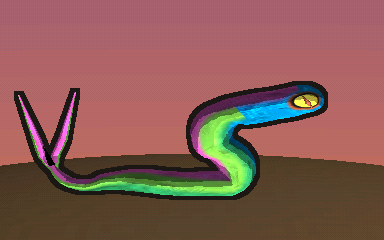
One of the owner’s two strongest v11 still references. It is not one of the ten new overhead options and does not share their inspection orbit.
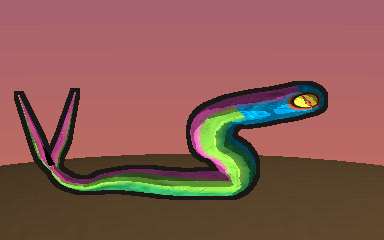
The owner’s other strongest v11 still reference. It is not one of the ten new overhead options and does not share their inspection orbit.
Zixxtrixx v11 · unselected baseline plus three lighting-only options
EXPERIMENTAL OWNER CHOICE — none of these alternatives is selected or released as the new standard. The v10 presentation above remains current. A bounded audit found the transformed-normal, outward-winding, interpolation and state machinery coherent; the shadow-clad read comes from the baseline key/fill/ambient arrangement. Every panel below holds the approved model, proportions, eyes, pigments, crayon texture, cel thresholds, pose, animation and camera identical, changing only named world-space lighting controls.
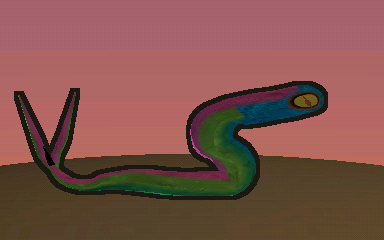
The preserved byte-identical baseline: elevated side/back key, below/opposite warm fill and cool ambient. Included for direct comparison, not as a fourth proposal.
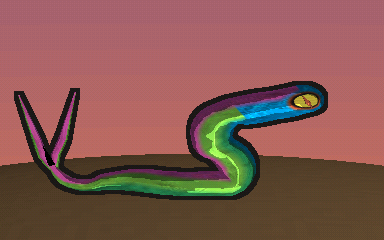
A restrained frontal/elevated key with low near-neutral fill: brighter face and inner S, while broad shadow remains for a quieter read.
A high camera-side key under stronger cool open ambient: the broadest colour read and least shadow-clad option.
Opposed camera-side key and warm fill: brighter overall than baseline, with a more sculpted split across the tube than High Open.
The same 24 idle ticks in every quadrant, ping-ponged only to make one smooth 0.77 second loop. Each quadrant retains its native 384 by 240 frame; use the controls or fullscreen to inspect threshold stability. No animation catalogue was rendered.